
AI's UNEXPECTED REVELATION
Artificial intelligence may not invent illusion. It may simply reveal the illusions we already live with.

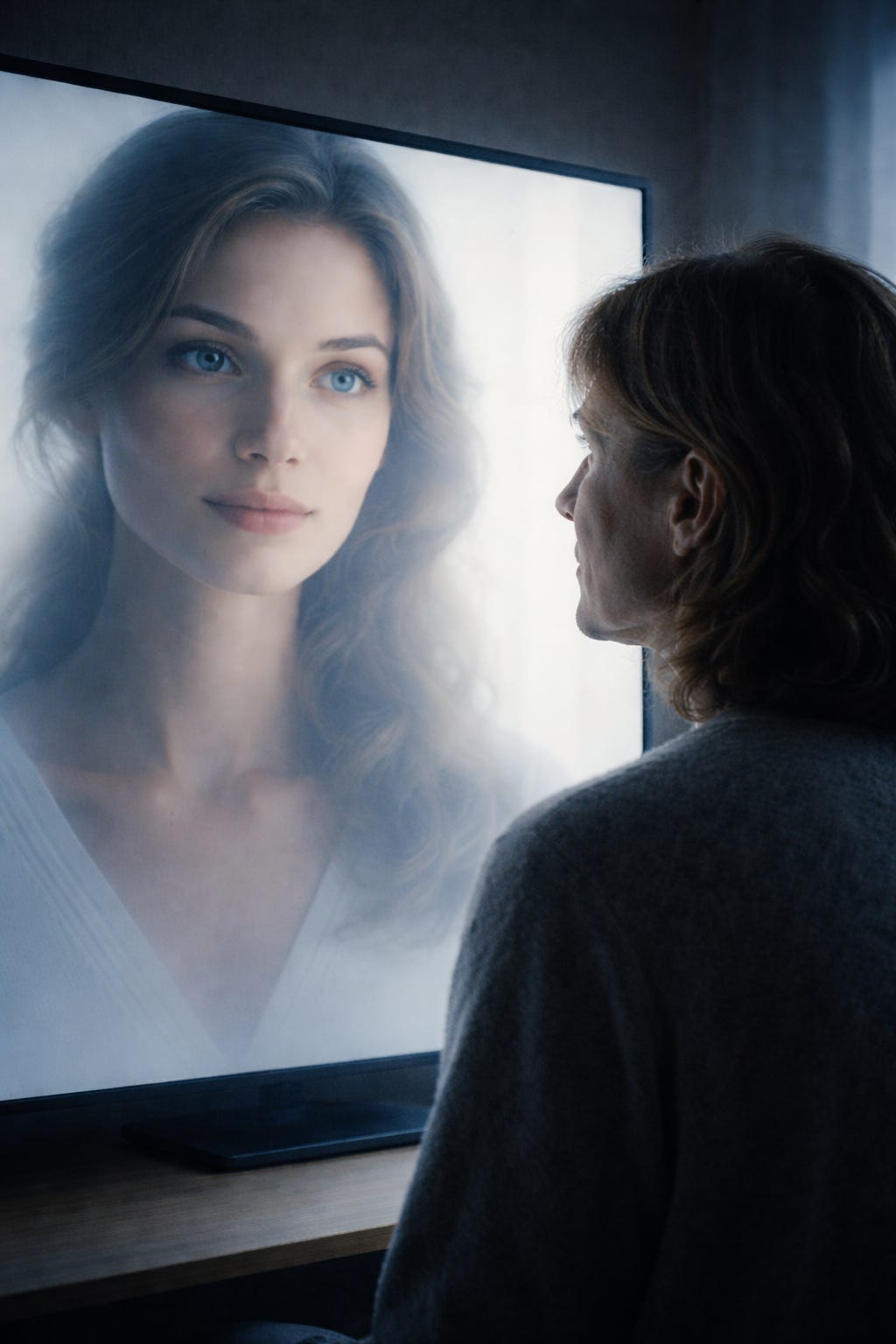
You see a stunning picture on social media.
Is it real, or AI-generated?
You read an article online.
Was it written by a human,
or by an algorithm?
You watch a video.
Who created it? A person… or a machine?
Suddenly, a quiet question enters our daily life:
How do we know what is real anymore?
With technology advancing at warp speed, machines can now produce faster and better many of the things humans used to create. Images, texts, voices, music. Reality suddenly feels slower, more limited, almost disappointing compared to the endless flow of synthetic possibilities.
Yet for our brains, the difference is surprisingly small. Whether the input comes from the physical world or from a digital simulation, it still reaches us through our senses and is processed in the same neural circuits. Our mind reacts to it as it always has.
For thousands of years, human societies evolved under conditions of scarcity. Economy itself was defined as the management of scarcity. Food, shelter, knowledge, tools, everything had value because it was limited.
Then came abundance.
First material abundance: more food, more goods, more comfort.
And now informational abundance: more images, more opinions, more advice, more content of every possible kind.
We consume information today almost the way we consume food.
A joke, a recipe, a lifestyle tip, a political opinion, a video, a photograph, every piece of information seems potentially useful. Somewhere in our evolutionary memory lies the quiet fear that tomorrow may require knowledge we do not yet have.
So we gather it. Constantly.
Our brain even rewards the process. Each new stimulus can trigger a small release of dopamine, the chemistry of anticipation and pleasure. In a world of scarcity, this mechanism helped us prioritize opportunities and store resources for the future.
In a world of unlimited information, the same mechanism can easily become excess.
Obesity, compulsive buying, binge-watching, endless scrolling. Entire networks are designed to keep us stimulated and entertained at the tip of our fingers.
Artificial intelligence now multiplies this dynamic. In a few hours, machines can generate more images, texts and videos than any human being could absorb in years. And much of it is offered for free.
You may know the warning: when something is free, you are the product.
At first glance, the future can look troubling. We are told that our intelligence may no longer be necessary for many tasks. At the same time, the very technologies that replace certain human activities also provide the entertainment that keeps us distracted.
If frustration appears, it can be expressed online.
If boredom appears, it can be filled instantly.
If anger rises, it can be released virtually.
Life continues.
Some years ago, the film Ready Player One imagined a dystopian world where people escaped reality through immersive virtual-reality devices. Today we may not even need such elaborate equipment. A simple smartphone and an internet connection are enough to feed our minds continuously.
But perhaps this technological transformation is not as unprecedented as it seems.
Human beings have always lived partly in constructed realities.
Our brains do not simply perceive the world. They interpret it, narrate it, distort it, embellish it. Memories reshape the past. Expectations reshape the future. Identity itself is built from stories we tell about who we are.
If we can no longer easily distinguish between synthetic images and real ones, how certain have we ever been about the narratives created inside our own minds?
In that sense, artificial intelligence does not introduce illusion into human life.
It amplifies a capacity that was already there.
The deepfake image may look convincing. But the deeper question it raises is unexpected: if we can no longer easily distinguish between a synthetic image and a real one, how certain have we ever been about the narratives created inside our own minds?
What if the shock produced by artificial illusions becomes an invitation to examine the older illusions we carry within us?
Our fears.
Our projections.
Our ego.
Our interpretations of past and future.
The Bible once expressed this idea with remarkable simplicity:
“Why do you look at the speck of sawdust in your brother’s eye and pay no attention to the plank in your own eye?”
(Matthew 7:3).
Perhaps the era of deepfakes will help us rediscover that wisdom in a new way.
For thousands of years, humanity has lived with illusions, some harmless, some comforting, some destructive. Artificial intelligence may simply reveal them more clearly by reflecting them back to us.
For a few people, that reflection will not be frightening.
It will be an opportunity.
An opportunity to ask again the simplest and most demanding question of all:
What is real?
The era of deepfakes may simply reveal the deeper illusions we have always lived with.
And am I willing to see it?
That question is where Pointfulness begins.